An Easy Beginner’s Guide to Rank Your Blog Articles On Google SERP:
If you’re new to blogging, you might be curious about how to get your blog posts to appear on Google’s first search results pages. To increase the rank of your blog article, you must follow a few SEO Optimization techniques which I have covered in this article that are essential for getting your site on Google’s front page. I used similar strategies during my early days to rank my blog posts and outperform many competitors.
Let’s Get Started!
What is SEO And How Does it Affect Your Google Ranking?

The technique of enhancing your website’s content and appearance on search engine results pages i.e. SERPs is known as SEO (Search Engine Optimization). To improve the quality and volume of organic traffic to your website, SEO requires both on-page and off-page strategies.
A website’s placement in the search engine results pages for a specific search query is referred to as its Google ranking. A website’s likelihood of receiving organic traffic from search engines increases with its SERP Ranking. On the Google ranking of your website, SEO can have a big impact. You may raise your website’s position by making sure it is technically sound, and user-friendly, and optimizing your website and its content for relevant keywords.
How to Rank Your Blog Article On The Front Page of Google Search?
1. Choose a Good Topic And Target Reasonable Keywords:
Ranking your blog articles on the first page is not by accident. It requires SEO knowledge, Keyword Research, and more.
If you wish to learn more about Keyword Research and The Tools to Conduct Keyword Research, you can check out my article and master your Professional Blogging Journey.
Also, you need to choose a good topic and be thoughtful while choosing keywords to produce SEO-optimized articles.
For example:
It might be hard to rank for a keyword like “yoga guide for beginners” as other marketers have already written a lot about it but “Yoga guide for beginners to stay cool” might be easy to rank as it has low competition. Your main concern should be on targeting low-competition keywords having the least volume.
You can use tools like WordStream’s free keyword tool to do keyword research as shown below:
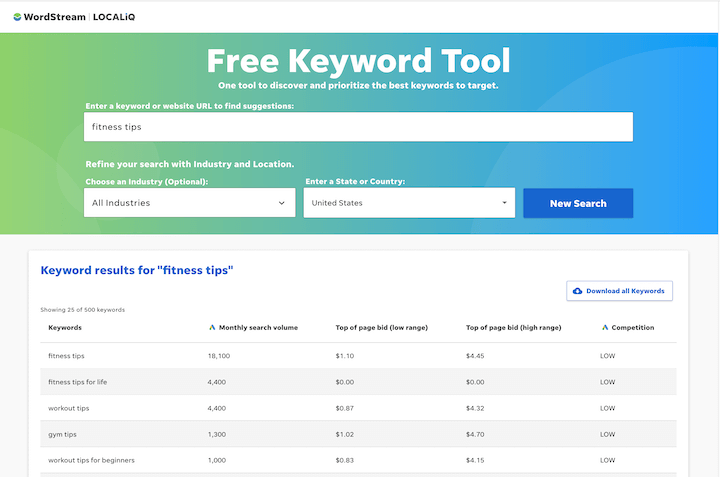
The factors involved in identifying the best keywords for ranking on Google are:
- Keyword Volume: It shows how often a particular term is searched on Google.
- Competition: It shows your competition with other marketers and hence the difficulty of ranking that keyword.
- Domain Authority: If you are publishing quality content for a while, it increases your domain authority over time and hence it will be easier to rank that keyword.
2. Write Adequately and Write Well:
The ranking of your blog article depends upon the quality of your writing and its adequacy. Therefore, ensure that the writing you produce is on par with high-quality, optimized content:
Make sure that the points mentioned below are included in your blog articles.
Conclusion: Some people jump over to the conclusion part before deciding whether or not to continue reading it. So be thoughtful while writing conclusions that summarize the important takeaways from the articles since you want to utilize them to summarize the key points of the post and inspire these readers to read the complete piece.
Introductions: The first thing that viewers see is the introduction part unless they directly move to the conclusion part so make sure it counts well. You should make it unique, informative, and eye-pleasing, and try to address the query with its solution as much as you can to make readers stay on the page.
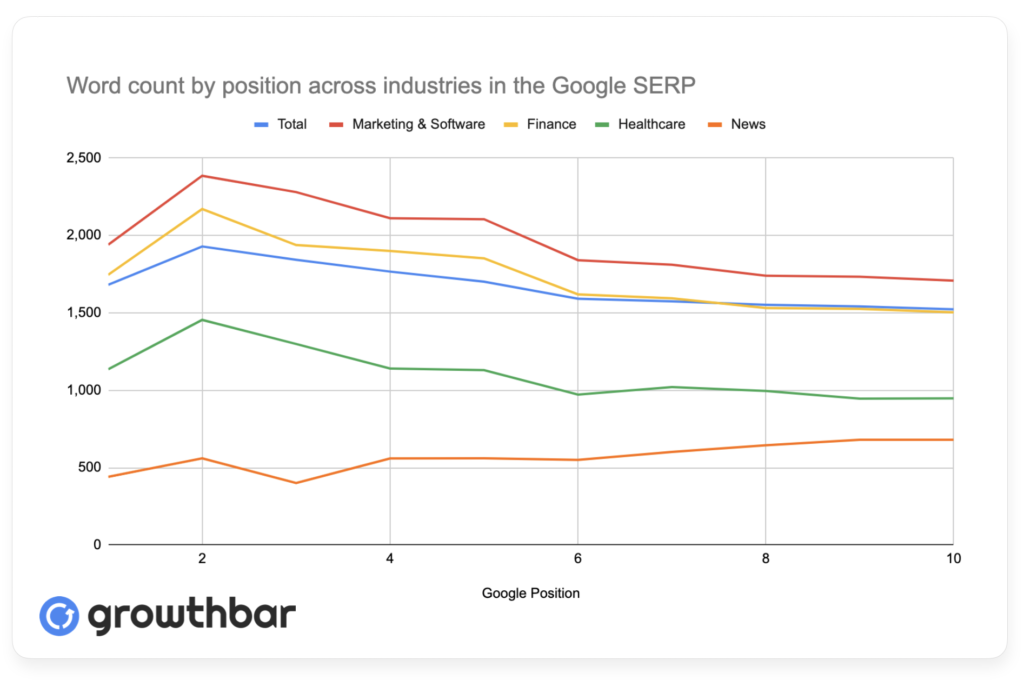
Proper length: Longer-form content performs better in the rankings across the majority of search verticals, so make sure yours is longer (at least 1000 words). There are many tools on the internet like Growthbar that let you make word count for free to improve SEO.
Keywords: Although the Head of Webmaster Trends at Google – John Mueller asserted that keyword density is not a matter of concern, it does matter to a certain degree. As per Google’s crawlers, your target keywords and other semantically related keywords have to appear in the content. Although you shouldn’t go overboard, you should frequently and early use relevant keywords.
The length makes it easier for content creators like you to give searchers what they want, this helps you get the highest SERP ranks. Keep in mind that content length differs per industry. For your specific search phrase, the finest tools, like GrowthBar, will be able to tell you how long your article should be, as well as which keywords to include, and more.
The given graph shows the word count by position across industries in the Google SERP.
3. Make Your Blog Articles Readable Using Good Formatting:
Long doesn’t always equate to long paragraphs. Many individuals have the habit of scanning the articles before continuing to read them thoroughly so you should assist the readers who won’t read 2,000 words of complex content.
Here are the best-practiced methods by professionals to format your blog post:
- To make the blog article easy to skim, ensure each part has distinct headings and significant points.
- Shorten the paragraphs by dividing them. There shouldn’t be more than 4 sentences in each.
- Using different lengths of sentence as mixtures of long and short sentences make blog entries simpler to read. Users are kept scrolling by it!
- Make sure that your blog articles look nice on mobile devices as mobile indexing is used first by Google to rank your content.
- For emphasis, use bullet points, numbered lists, and bolding.
Also, Include tables, charts, infographics, and illustrations to demonstrate more complicated ideas or thoughts or just for fun.
4. Linking (External or Internal):
To make a blog article rank there must be internal and external linking between articles because it develops trust in Google’s eyes moreover it helps to keep people on your site.
- Link To Reliable Sources (External Linking): I’ve discovered time and time again that the initial few paragraphs of our best-performing posts contain external links to very reliable sites. Link to Mayo Clinic or academic papers while generating medical content or trying to increase SEO for doctors. This demonstrates to Google that quality is what you value most.
- Internal Linking: One of the most crucial things you can do to rank in search engines is internal linking. Higher placement in the SERP (search engine results page) is correlated with more internal links. At least two to three links to other blog posts or the main website should be included in each blog article. This helps to rank your blog articles and also helps the audience to navigate between many articles.
5. The URLs Keyword Matters:
SEO is impacted by the way your URLs are structured. Include as many of your keywords as possible in the URL of the article. Avoid utilizing changing elements when creating URLs since if you do, all internal and external links will stop working when you edit the URL.
For instance, if you create a URL with “five ways to get ranked on Google”, but later decide to make it “six steps”, all of the internal and external links will be broken. Also any, backlinks to this article from other sites will be lost.
Apart from this a better UI/UX experience, fast site loading speed, and consistency in publishing articles are also needed to rank your site on Google SERP.
Factors That Outrank Your Blog:
There are so many factors that outrank your blog articles ranging from copying others’ content to poor keyword research and many more.
Let’s discuss some of the major mistakes that should be avoided while making blog articles:
1. Using an Inappropriate Name For Your Blog:
Companies can sometimes make an attempt to develop a blog that would appeal to them. This has the drawback of not being appealing to their audience. If they do click on it at all, they decisively leave the page as a result.
When developing your blog, make sure to pick a name that is memorable, reflects who you are as a person, fits with your brand, and is fascinating.
Additionally, make an effort to provide readers a hint as to the themes they might anticipate reading about once they get on your page.
2. Not publishing Articles Consistently:
Publishing frequently and consistently is a crucial component of a successful blogging strategy. Sometimes businesses create a blog, publish a rush of entries, and then their page becomes dormant. An outdated, lifeless page is unappealing.
Furthermore, if you don’t regularly share your knowledge and skills in your industry, no one will look to you as the authority in it.
The advantages of regular, frequent publication include:
- More active visitors live
- demonstrating to visitors that your website is active.
- Your content is regularly indexed by Google and other search engines.
In the end, sticking to a predictable publishing schedule shows readers that you care about their needs and are dedicated to giving them the knowledge they need.
3. Choosing The Wrong Topics:
Answering your customers’ inquiries is the main goal of blogging. Unfortunately, a lot of businesses that struggle with blogging do so because they forget to prepare the material that readers will want to know.
Find out from your sales team what kinds of inquiries clients make the most frequently; all of these make excellent prospective blog articles. Aim to respond to your audience’s questions through consistent blog entries after you’ve identified the most common ones your business receives.
Even better, guess what they’ll want to know and tell them before they ask. You’ll learn how to supply the ideal topics people actively want to read about once you’ve had enough experience blogging and industry knowledge.
4. Ignoring SEO Optimization in Your Article:
Finding a topic and putting words on a page to produce engaging content is simply one aspect of the process. The other, somewhat less appealing, component of content marketing is spending money on top SEO techniques.
Search engine optimization, or SEO, is a crucial element you require in order to drive visitors to your blog.
Although you should write primarily for your readers, you also need to write for search engines if you want to rank well on Search Engine Results Pages (SERPs).
Among the essential SEO best practices are:
- creating blog headlines that are SEO-friendly.
- include suitable keywords.
- recognizing search query intent from the user.
- by the use of links, both internal and external.
- optimizing the URL for each blog post.
Include these techniques in your blog to draw more visitors to your site and rank your site.
5. Not Using Internal and External Linking:
Each blog entry should cover a wide range of topics, but let’s face it—reading material frequently leads to more queries.
It’s hard to answer all of the queries in a single blog post. The best strategy to provide more information is to link to your blog’s material from both internal and external pages.
Internal links are a fantastic technique to increase traffic to your own website and further demonstrate to readers the importance of your blog and website.
External links increase your authority, boost your website’s SEO, give readers references, and generally give audiences more for their money.
Don’t worry that your efforts will be undermined by external links. If anything, doing so demonstrates to readers that you prioritize their requirements over your own. Furthermore, you can set the external linked site to open on a new page when clicked so that both pages can run simultaneously.
Conclusion:
In conclusion, ranking your blog posts is crucial for effective blogging. Although optimizing your blog for search engines can be difficult, it is essential to make sure that your material is seen by the people you want to reach. You may increase your blog’s exposure and draw in more organic visitors by putting efficient SEO tactics into practice, such as conducting keyword research, writing excellent content, constructing backlinks, and making sure the on-page optimization is done correctly. Keep in mind that ranking is a continuous process that calls for perseverance and regular effort. You may progressively raise your blog’s rating and build a significant online presence in your field by being persistent and committed.